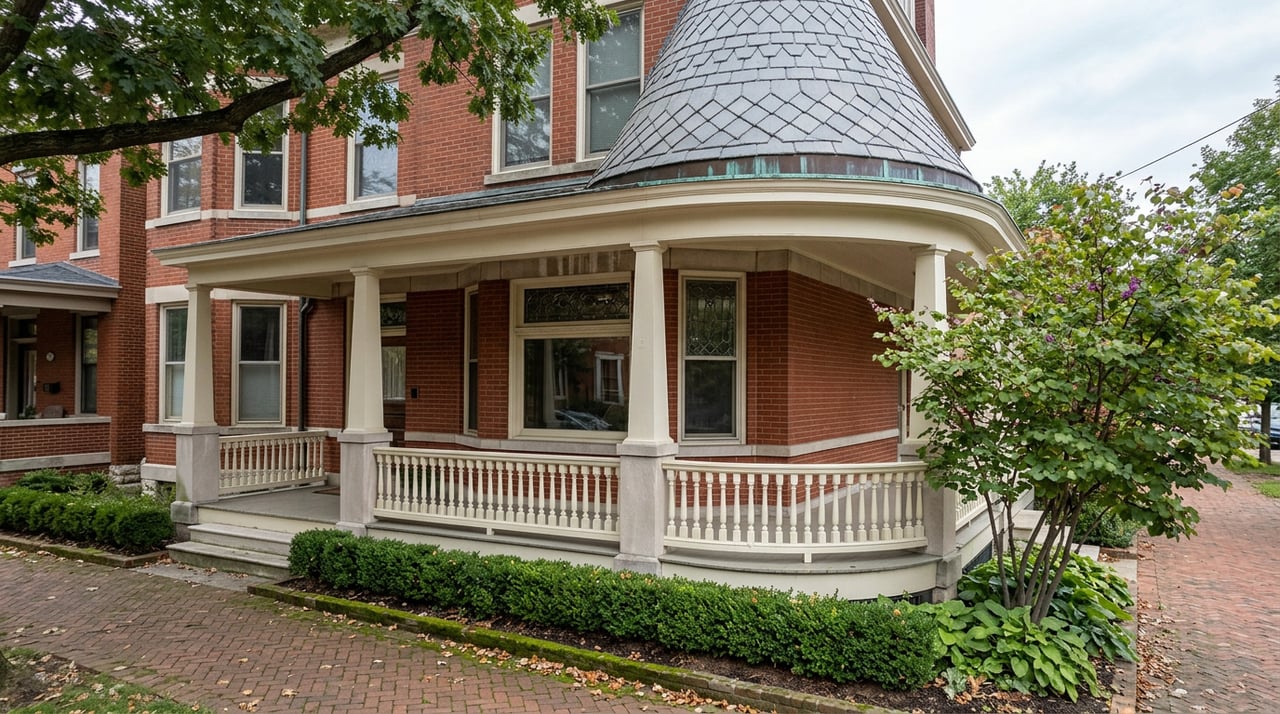
Buyers who fall for a Victorian on St. James Court or a limestone-fronted rowhouse near Fourth Street usually do their homework on one number: the 30 percent state tax credit that can offset restoration costs on a historic home. It sounds like free money for anyone willing to do the work right. What most buyers don't know is that the pool of money behind that credit was just rebalanced by the Kentucky legislature, the state's own preservation office has paused new residential applications while it rewrites the rules, and the next chance to apply under the updated system won't open until April 15, 2027.
That timing matters if you're closing on a property this fall and planning your rehab budget around a credit you haven't confirmed is actually available. Before that credit ever comes into play, though, two other approvals have to happen, and neither one moves at the speed most out-of-town buyers expect. Here's the order things actually go, and what changes the math along the way.
The First Approval Isn't the Bank's
Old Louisville has been a locally designated Preservation District since 1974, which means any exterior change to a home in the district, from a porch rail to a roof to a window sash, requires a Certificate of Appropriateness before the work starts, not after. The city's Office of Planning administers this through the Old Louisville Architectural Review Committee, a subcommittee of the Historic Landmarks and Preservation Districts Commission.
The process splits into two tracks depending on scope:
| Review Level | Handles | Turnaround |
|---|---|---|
| Staff-level | Minor, routine work that clearly meets the design guidelines | Case manager review, no public hearing |
| ARC (committee)-level | Demolition of contributing structures, new construction, larger or more visible projects | Monthly meeting, public comment, formal vote |
Applications are due by Friday to be assigned to a case manager the following Monday, so plan around that cycle rather than assuming same-week answers. If the ARC denies a request, the owner has 30 days to appeal to the full Landmarks Commission. If the denial involves demolition or new construction, there's a separate 10-day window to request an economic hardship exemption, which requires its own documentation. None of this is unusual for a historic district. What catches buyers off guard is discovering, after closing, that the roof replacement or window swap they assumed was routine maintenance actually needed a COA first. Skipping that step can trigger enforcement action from the city, not just an awkward conversation with a neighbor.
The Second Approval Comes From an Underwriter, Not a Preservationist
Old Louisville's building stock is overwhelmingly late 19th and early 20th century, which means a meaningful share of these houses were originally wired with knob and tube, a system of porcelain knobs and tubes that carries copper conductors through open air rather than sealed conduit. It's legal to leave in place. It's the insurers and lenders who make it a problem. Most standard homeowners policies won't cover a house with active knob and tube, and most mortgage lenders require a passing electrical inspection before closing, which knob and tube systems typically fail outright.
The practical effect is that a buyer who loves a house's original woodwork and leaded glass can still hit a wall at underwriting if the electrical panel tells a different story than the parlor. Depending on the insurer, the options are to commit to a full rewire within a set window, accept a stripped-down policy with less coverage, or pay a specialty carrier a significantly higher premium to cover the home as is. None of those are deal killers, but all three change your closing timeline and your first-year budget, and none of them show up on a standard seller's disclosure the way a leaking roof would.
The Third Approval Is the One Everyone Assumes Is Automatic
This is where the math buyers count on gets complicated. Kentucky's Historic Rehabilitation Tax Credit, administered by the Kentucky Heritage Council, offers owner-occupied residential properties a credit worth 30 percent of qualified rehabilitation expenses, with a project cap of $120,000 on a $400,000 project. To qualify, the property has to be listed on the National Register of Historic Places, either individually or as a contributor to a district, which describes most of Old Louisville's housing stock. The minimum qualifying investment is $20,000, and the work has to follow the Secretary of the Interior's Standards for Rehabilitation, meaning repair and preservation take priority over full replacement.
Here's what changed. The state's total annual credit pool sits at $100 million, and for the past several years roughly a quarter of that was set aside specifically for owner-occupied homeowners, the rest going to commercial and income-producing projects. Earlier this year, the legislature passed HB 757, a revenue bill that took effect April 30, 2026 and shifted the split so that 85 percent of the pool is now reserved for commercial development, leaving a much thinner slice for homeowners. A nonpartisan review of the session's final days described how the bill moved through what it called "a process that permits a final, non-amendable vote without public oversight," passed in the closing hours before the legislature recessed.
The practical consequence, as of this writing, is that the Kentucky Heritage Council is not accepting new State Part 1 or Part 2 applications at all. The agency is rewriting its administrative regulations and forms to match the new law, and the next allocation round has a stated deadline of April 15, 2027. If your renovation budget assumes a $30,000 or $60,000 credit landing sometime next year, that assumption now depends on a smaller residential pool, a paused application window, and a state timeline that runs on its own schedule, not your closing date.
What This Actually Means on St. James Court or Fourth Street
None of this changes what makes Old Louisville worth buying into. The district still holds one of the largest concentrations of intact Victorian architecture anywhere in the country, and the story behind it is a genuinely local one. In 1961, a small group calling itself Restoration, Inc. started buying and renovating homes on Belgravia Court, eventually restoring eleven of them, and their example is a real part of why the neighborhood survived the decades when families and money moved east. The St. James Court Art Show, first held in 1957 as a fundraiser to reverse the district's decline, still runs every October and remains one of the events that keeps the neighborhood's identity visible citywide.
What the current credit squeeze means practically is that a buyer weighing a fixer-upper on Fourth Street against a move-in-ready condo near Central Park should treat the tax credit as a possible bonus, not a line item in the offer. If restoration costs only pencil out with a $60,000 or $120,000 credit baked in, that plan needs a backup that works without it, at least until the 2027 allocation round opens and its actual terms are published.
Before you write an offer on a historic property in this district, it's worth confirming three things up front:
- Whether any planned exterior work, including things sellers describe as "recent updates," actually received a Certificate of Appropriateness, since unpermitted work can follow the property to you
- Whether the home's electrical system has been fully rewired or still carries knob and tube, and getting that answer in writing before you're deep into a mortgage commitment
- Whether your contractor's proposed rehab plan would even qualify as a Qualified Rehabilitation Expense under the Secretary of the Interior's Standards, since not every renovation dollar counts toward the credit even when the credit is available
A Few Questions Worth Asking Directly
Does every exterior change need a Certificate of Appropriateness? Most do. The city's guidance is to consult Planning staff before making any exterior change, since even work that seems minor, like a fence or paint color on trim, may fall under review depending on visibility and materials.
Is the tax credit gone for good? No. The program itself continues, and the annual pool is still $100 million. What's changed is the share reserved for homeowners and the current pause on new applications while regulations catch up to the new law.
Does knob and tube wiring automatically kill financing? Not automatically, but it complicates it. Expect the lender's required inspection to flag it and expect most standard insurers to decline coverage until it's addressed, either through replacement or a specialty policy.
Buying in a district like this rewards patience and a clear-eyed read of the paperwork as much as it rewards an eye for architecture. If you're weighing a specific property in Old Louisville, or trying to figure out what a renovation actually costs once the credit math is uncertain, Michael Mawood has spent more than three decades living in and working on these blocks, including time on the district's own Architectural Review Committee. Let's Connect before you write the offer, not after.