In 1995, a homeowner in Indian Hills found himself sued twice over the same septic tank. His neighbors sued him. Jefferson County sued him. The tank was overflowing, and neither the homeowner nor the septic companies he called could fix it without connecting to the city sewer system. There was just one problem. A sewer trunk line had been running through Indian Hills since 1992, three years earlier, and it connected to nothing. Not one house in the city was hooked up to it.
That contradiction, a working sewer line with no customers, is not a footnote in Indian Hills history. It is the reason the neighborhood looks and prices the way it does today.
A City That Kept Saying No
Louisville first tried to bring sewers to Indian Hills in 1954, proposing annexation as the mechanism to extend service. The opposition was so total that the Courier-Journal could not find a single Indian Hills resident willing to go on record in favor of it. Two years later, Louisville folded the idea into the larger Mallon Plan, an attempt to annex most of the city's outlying suburbs at once. Leaflets circulated in Indian Hills warning that taxes would rise, city buses would start running down residential streets, and sewer hookups would come with expensive bills attached. Louisville voters approved the plan by a wide margin. Suburban voters, including Indian Hills, rejected it two to one. The Mallon Plan died.
By 1988, Louisville tried again, this time offering sewers without annexation attached. Indian Hills voted it down four to one, even though running a line through the city was the only economically viable way to extend service to communities further east that had already voted yes. Legal challenges over the rejected plan delayed any construction until 1992, when a line finally went in through Indian Hills. It served everyone downstream and nobody inside city limits.
The standoff held for three more years, until the overflowing tank and the two lawsuits it produced made the arrangement untenable. Mayor Jeanne Beam, who had opposed sewer connection for 22 years in office, resigned that June, shortly after city commissioners signaled they would stop fighting the connection. The project that followed, starting in 1999, became the most expensive sewer construction in Jefferson County's history. Residents paid between $20,800 and $31,200 each to finally tie in.
Add it up and the resistance ran from that first 1954 proposal to the 1999 connection: 45 years of a city choosing septic tanks over sewer lines, on purpose, at real political and financial cost.
What the Fight Actually Protected
None of that resistance was really about pipes. It was about density. A sewer connection makes it economically possible to subdivide larger parcels into smaller ones, because septic systems require room for a drain field and sewer lines do not. By refusing the connection for nearly half a century, Indian Hills residents were also refusing the subdivision pressure that tends to follow infrastructure. The lot sizes you see in the city today, several of them exceeding an acre even on interior streets, are in part a byproduct of that refusal holding for as long as it did.
The city's own land record backs this up in a different way. Over a third of Indian Hills remains intentionally undeveloped woodland, most of it along Indian Hills Trail between the Louisville Country Club and the Ohio River. Ten sections of the city were originally laid out by the Olmsted Brothers landscaping firm starting in 1911, when the Veech family, who had owned the land as a horse farm since the early 1800s, hired the firm to plan a golf course and residential subdivision around it. The Louisville Country Club opened on part of that land in 1924. Two houses from that original development era, Midlands, built in 1913, and Blankenbaker Station, built in 1916 as one of Louisville's first fireproof homes, are listed on the National Register of Historic Places today.
Early lot restrictions required homes to sell for at least $10,000, a floor raised to $20,000 in 1946 as postwar construction filled in the subdivision. That means the housing stock you'll find in Indian Hills spans country club-era construction from the 1920s through the postwar decades that followed the 1946 price floor, which is worth knowing before you assume an older listing means an Olmsted-era original.
What Your Money Is Actually Buying
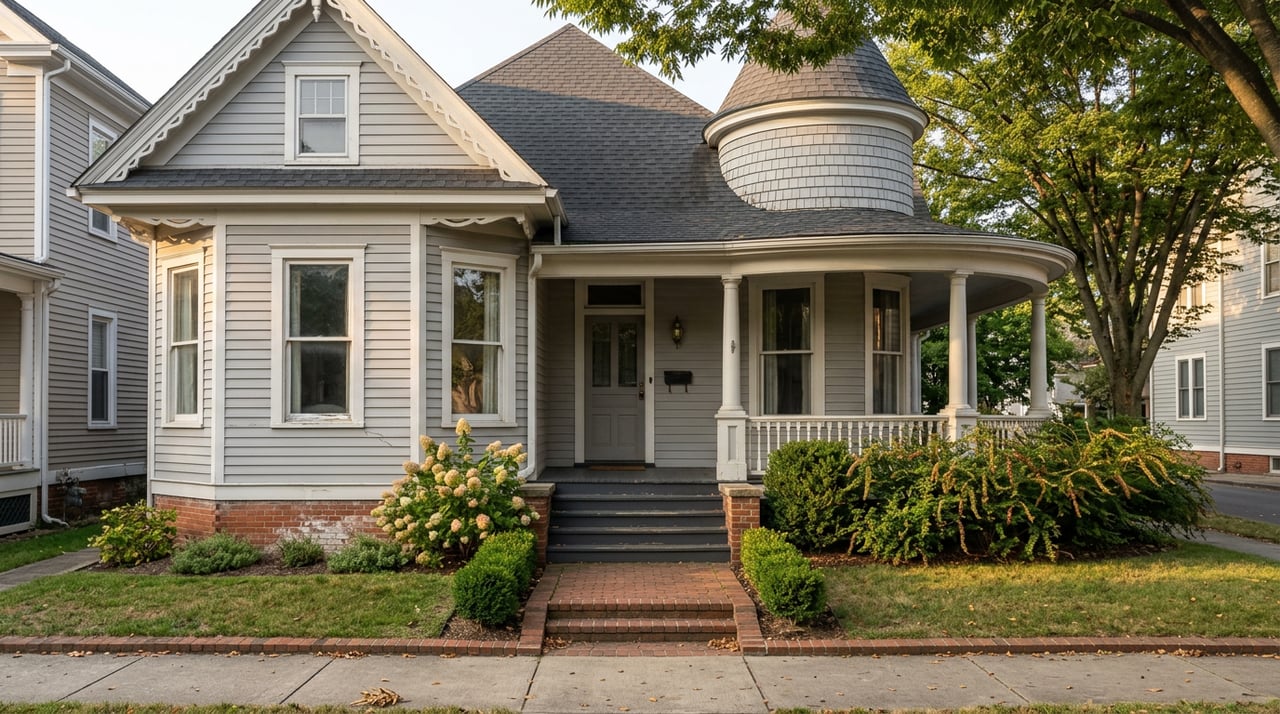
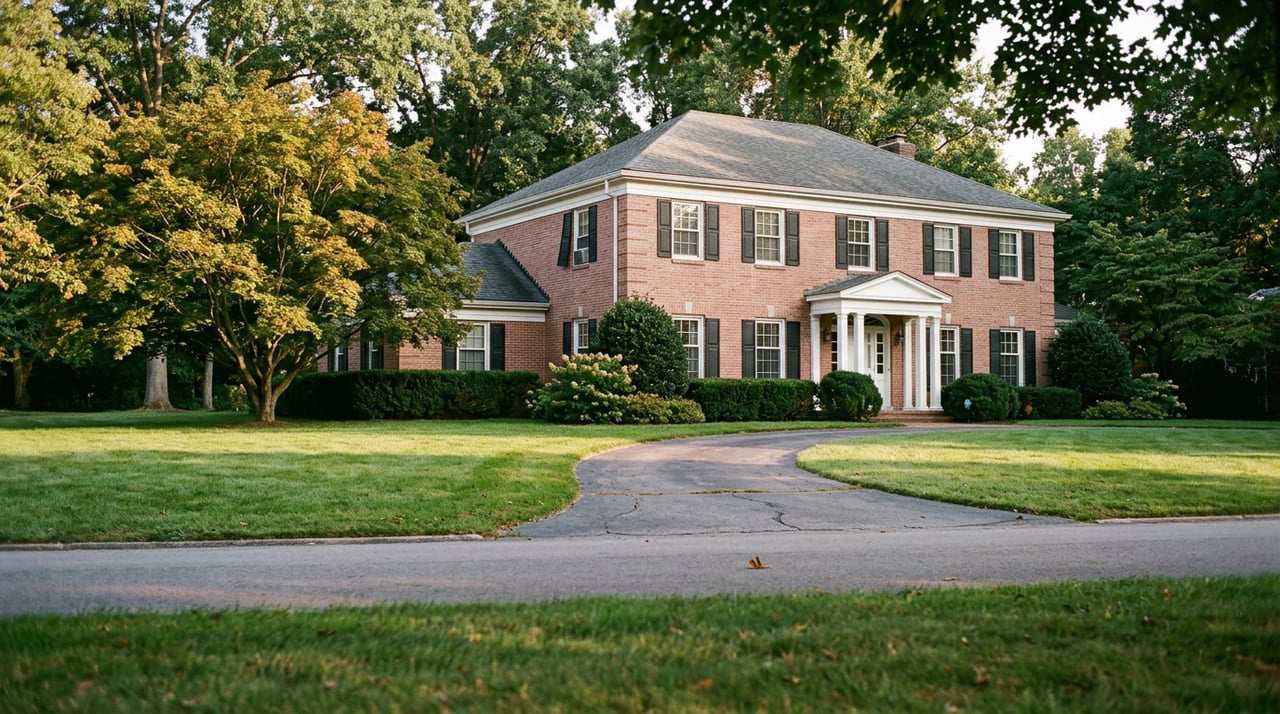
Here is where the sewer fight shows up on a listing sheet. Two homes listed in late May 2026 illustrate it well. A four-bedroom house on Sagamore Road, built in 1927 with 4,811 square feet, listed at $1,950,000, works out to roughly $405 per square foot. A five-bedroom house on Totem Road, built in 1952 with 3,695 square feet, listed at $1,195,000, works out to roughly $323 per square foot. The newer house has more bedrooms and a lower price per square foot than the older one. If you were pricing purely on size and room count, that ordering would run the other way.
It doesn't, because square footage was never the whole product in Indian Hills. Lot size, setback, tree cover, and proximity to the undeveloped Olmsted-era sections all move price independently of the house itself. That is also why any single median price you find online this year should be read with some skepticism. Redfin recorded a median sale price of $655,000 in February 2026, down 22.5 percent from the year before, with a median of $158 per square foot. Other aggregators tracking the same small handful of active listings this spring put the median closer to $900,000. Both numbers can be accurate and still tell you almost nothing on their own, because Indian Hills sells so few homes in a given month that one large or small transaction can swing the median by six figures. A market this thin rewards a buyer who asks what a specific lot and structure are actually worth, not one who anchors to whatever number a portal displayed that week.
Public parcel records for the neighborhood back up the pattern. A corner lot on Indian Hills Trail, built in 1950, carries a tax record of 1.09 acres, nearly 48,000 square feet, which is not unusual for the area and helps explain why per-square-foot comparisons to denser Louisville neighborhoods rarely hold up cleanly.
The Country Club Ties It Together
The same 1920s land deal that created the residential lots also created the Louisville Country Club, and that connection is still visible on the calendar. This year, Indian Hills Country Club will host the Kentucky Open for the first time in the tournament's 107-year history, with 156 professional and amateur golfers teeing off in late July 2026. The club has hosted other significant events recently, including the Kentucky Amateur in 2022 and the Kentucky Mid-Amateur in 2025, but never the Open itself. It is a small detail, but it is a useful reminder that the country club was never an amenity bolted onto Indian Hills after the fact. It was part of the same 1924 transaction that shaped the streets around it, and its role in the neighborhood's identity has only grown since.
Questions Worth Asking Before You Write an Offer
A few things are worth confirming with any Indian Hills listing before you get too far into a transaction.
- Ask when the specific property connected to sewer. The citywide project began in 1999, but confirm the individual parcel's hookup date and whether any assessment balance remains attached to the property rather than the prior owner.
- Check flood zone status if the address sits north of Interstate 71 or near Beargrass Creek. Much of that area sits in the 100-year floodplain, and the Indian Hills Road and River Road intersection floods seasonally in spring.
- Confirm which of the four original cities the parcel came from. Indian Hills as it exists today merged four separate municipalities, Indian Hills-Cherokee Section, Robinswood, Winding Falls, and the original Indian Hills, in 1999. Older records and easements sometimes still reference the pre-merger city.
- Get the actual lot survey, not just the tax record acreage. Given how much of this market's value sits in land rather than structure, an acre-plus lot with an unusual shape or easement can change what you're able to build or add later.
Quick Answers
Are Indian Hills homes still on septic systems today? Most homes connected to city sewer through the project that began in 1999, which is the last major infrastructure event on record for the city. Anyone considering an older home should still confirm the individual connection date rather than assume it.
Why do median price estimates for Indian Hills vary so much between sources? The city sells very few homes in any given month, and lot size and construction era vary widely from street to street. A handful of transactions can shift a monthly median by a wide margin, which is why the figure is more useful as a starting conversation than a fixed number.
How much of the city is still undeveloped? Over a third of Indian Hills remains intentionally undeveloped woodland, concentrated along Indian Hills Trail between the Louisville Country Club and the Ohio River.
If you're weighing Indian Hills against another Louisville neighborhood, or trying to figure out what a specific lot's history means for resale, Michael Mawood has spent more than three decades working through exactly these questions on Louisville properties old and new. Let's Connect.