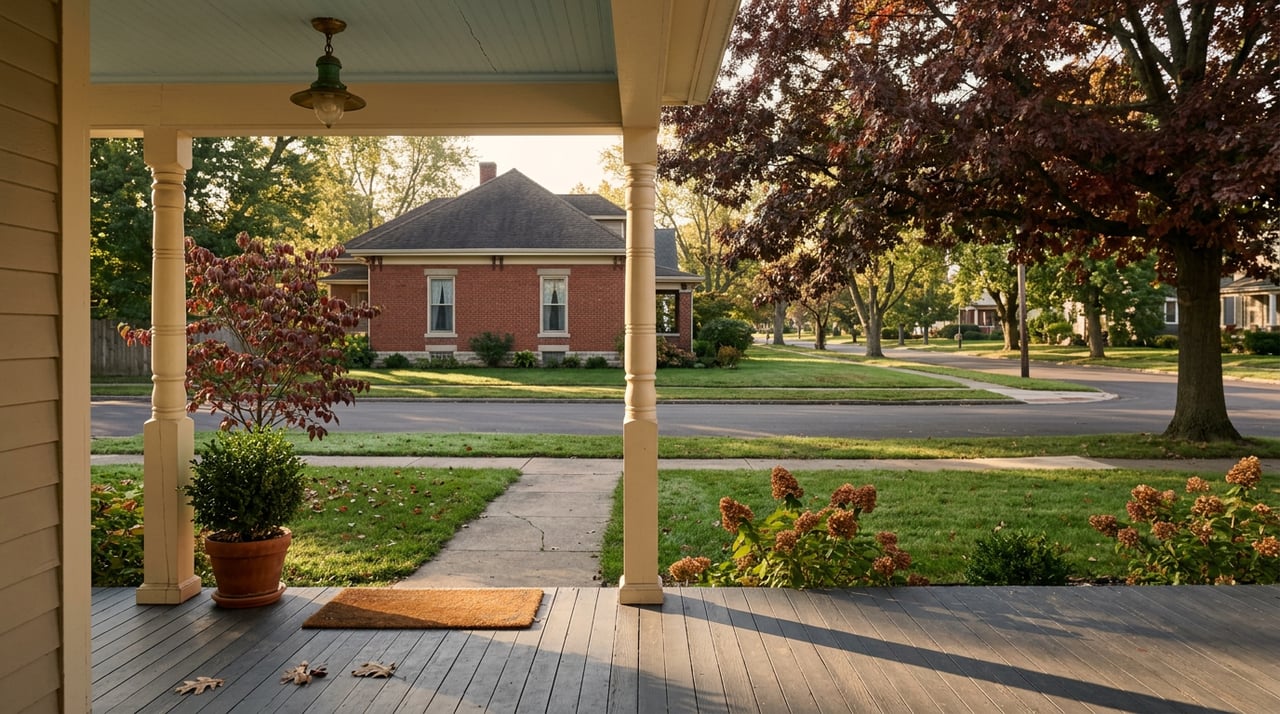
Walk east from the reservoir on a Saturday in October and you pass a museum that did not exist last spring, a nine-hole course marking its centennial, a library with fresh drainage and new native trees, and roughly a dozen small businesses that have been the neighborhood's Saturday routine for years. None of it is coincidence. The fall of 2026 is the season Crescent Hill's oldest civic institutions all get recommitted to at once, and the Frankfort Avenue grid is what lets you visit them without moving your car.
If you have lived here five years or fifty, this is the argument worth holding: the neighborhood is not being reinvented. It is being reinforced.
October 30 on Frankfort
The most concrete change on the avenue arrives at 1839 Frankfort. That is where The Dot Experience opens its doors on October 30, 2026, replacing the small museum that has quietly sat on the American Printing House for the Blind campus for decades. The new building runs roughly 28,000 to 30,000 square feet, which makes it about five times the footprint of what came before, and it is designed to function as the front door of an institution that has been publishing braille here since 1858.
A few specifics worth carrying in your head before you go:
- Hours are daily, 10 a.m. to 5 p.m., with closures on New Year's Day, Derby Day, July 4, Thanksgiving, Christmas Eve, and Christmas Day.
- Factory tours of the working APH facility run four times a day at 10:15 a.m., 11:15 a.m., 1 p.m., and 3 p.m.
- The second gallery holds the Helen Keller Archives, with tactile replicas oriented the same way as the originals so blind and sighted visitors read the objects the same way.
- The Breakthrough Gallery includes a LEGO Foundation area for building with Braille Legos and a Microsoft-supported inclusive gaming station.
The museum expects 30,000 to 50,000 visitors a year once it settles in. For a resident, the more useful frame is that a place you have walked past for years is about to become the reason friends from Cincinnati and Nashville drive down for a weekend. It also means the stretch of Frankfort between roughly 18th Street and Ewing is going to see steadier daytime foot traffic than it has carried in a generation.
A Hundred Years Up the Hill
Three-tenths of a mile away, on Brownsboro Road, Crescent Hill Golf Course turned 100 this year. It opened in 1926 as Louisville's second municipal course, and the city marked the centennial with a small event on the grounds this summer, complete with free food, short lessons from the pro, and a visit from Mayor Greenberg.
The interesting piece is not the party. It is who now looks after the turf.
After a difficult summer of 2025 on the city's courses, Louisville hired its first-ever golf agronomist, Mark Wilson. Wilson previously ran conditions at Valhalla during the 1996 and 2000 PGA Championships, the 2004 Senior PGA, and the 2008 Ryder Cup.
That is a Ryder Cup superintendent now paying attention to a nine-hole muni that has three par-threes, three par-fours, three par-fives, no water hazards, and no bunkers. If you play the course, or if you use its edges as a walking loop, the practical translation is that the fairways and greens should look measurably better next spring than they did last one. The centennial is the headline. The agronomist is the story.
The Block Between Them
The reason these two anchors matter to a current resident is that everything you would already do on a Saturday sits between them. Frankfort Avenue is dense enough that you can string the museum, the golf course, breakfast, a bookstore, and a bottle of wine into a single afternoon without a second parking space. A partial list, with the addresses that make the geography click:
- Blue Dog Bakery & Café for a croissant and coffee before the day starts. New owner Libbie Ackerman Loeser took over recently and the counter line still forms before the doors open on cold Saturdays.
- Con Huevos at 2722 Frankfort Ave, the James Beard-nominated Mexican breakfast spot, still open only for breakfast and lunch.
- Just Creations next door at 2720 Frankfort Ave, the fair-trade nonprofit shop stocking work from artisans in more than 45 countries.
- Carmichael's Bookstore, Louisville's oldest independent, in business since 1978.
- Porcini, the Northern Italian dining room that has been serving Crescent Hill since 1992.
- Varanese at 2106 Frankfort Ave, with the four-season patio and the 20-foot slate water wall.
- The Wine Rack for tastings on Thursday and Friday, plus bread from Blue Dog and cheese from Lotsa Pasta on the same shelf.
- Pretty Decent for botanically inspired cocktails inside a working botany shop.
- Gallant Fox Brewing and Apocalypse Brew Works for the small-batch side of the beer scene.
- Guestroom Records for the vinyl stop most residents already have on their monthly rotation.
None of this is new. That is the point. The businesses that will handle the tourist bump from The Dot Experience are the same ones long-term residents already treat as extensions of the kitchen and the living room.
What's Quietly Getting Fixed
Two smaller stories round out the season, and they are the kind of thing you only notice if you actually live here.
The Crescent Hill Library, 117 years old and one of the neighborhood's original civic buildings, is in the middle of a grounds refresh. New drainage, new ground cover, and native trees went in ahead of the Frankfort Avenue Easter parade, with the stated goal of cooling the site and thickening the tree canopy over that block. It is a small project. It also means the corner most residents walk past twice a week is being invested in on a timeline measured in decades rather than seasons.
Half a mile east, on the Clifton side of the avenue, the former Enso space reopened February 5 as Mill Iron 4, a barbecue and whole-animal butchery from pitmaster Dustin Olsen and Noam Bilitzer, who was named a 2026 James Beard Award semifinalist. Reservations were booked out within days. For Crescent Hill residents, this is the closest new restaurant of any real ambition, and it slots into the Frankfort Avenue restaurant row without disturbing what was already there.
Why This Fall Lands Differently
Line up the year's civic dates and a pattern shows up that no single announcement makes visible:
| Institution | Founded | What happened in 2026 |
|---|---|---|
| American Printing House for the Blind | 1858 | The Dot Experience opens October 30 |
| Crescent Hill Reservoir & Gatehouse | 1879 | Continues as the neighborhood's daily walking loop |
| Crescent Hill Library | ~1908 | Grounds refresh, new native canopy |
| Crescent Hill Golf Course | 1926 | Centennial celebration, first city golf agronomist hired |
| Peterson-Dumesnil House | 1870 | Hosted the 250th-anniversary Fourth of July Festival |
Five institutions built between the Civil War and the Coolidge administration, all receiving deliberate attention in the same twelve months. That is what sets Crescent Hill apart from the neighborhoods it is often lumped in with. Elsewhere in Louisville, the fall news cycle is dominated by new construction and new tenants in old shells. Here it is the opposite. The buildings and businesses that were already worth keeping are getting the money and the staff and the design work that let them keep going.
For a resident, the practical takeaway is quieter than a press release. The tree in front of the library will be shading the sidewalk in ten years. The fairways at the golf course should recover from a rough summer. The museum on the corner will pull enough visitors to keep the Saturday breakfast places busy through the slow months. The block you already know is being underwritten for another generation.
That is a different thing from a neighborhood on the rise. It is a neighborhood that is being kept.
If You Want to Talk About the Block
The character of Crescent Hill sits in details most agents flatten into a listing paragraph: which porches face the reservoir, which streets carry the parade route, which blocks lost trees in the 2023 storms and which ones did not, which houses still have their original slate. If you own here and are thinking about what your home is worth as this fall's investments settle in, or if you are looking at a Crescent Hill purchase and want a candid read on a specific block, Michael Mawood has spent more than three decades working with historic and architecturally distinctive homes across Louisville's preservation districts. Let's Connect.